I have collected some citations, sources and useful links for scholars and whoever would like to dive deeper to the thought above:
Note 1: We can freeze, we can attack, but we also love risk and embrace challenge.
For the Fight-or-Flight Response and Human Fear Transformation:
Cannon, W. B. (1915). Bodily Changes in Pain, Hunger, Fear and Rage. New York, NY: D. Appleton & Company.
This is the original work describing how humans respond to fear by mobilizing energy for "fight or flight" - supporting the idea that we transform fear into action.
Popularized the concept that fear generates physiological energy that prepares humans for action.
For Defense Cascade and Freeze Responses:
Documents the progression of fear responses (freeze, flight, fight) and notes that humans have multiple response options, unlike many animals that follow more rigid patterns.
For Risk-Taking and Fear in Humans:
Lerner, J. S., & Keltner, D. (2001).
Fear, anger, and risk. Journal of Personality and Social Psychology, 81(1), 146-159.
For Fear as Learning Mechanism:
Describes how fear serves adaptive learning functions, helping humans learn to identify and respond to threats.
Research showing how humans can learn fear responses not just through direct experience but through observation, demonstrating the learning aspect of fear.
Note 2: Throughout history, humans have created religions, ideologies, and worldviews. All share something in common: they all possess a compass. They all believe that human life has purpose. Living without direction, without a compass, proves extremely difficult.
"In the debate about human nature, virtually no one denies that humans have an impulse to search for meaning, to ponder the perennial worldview questions, and to wonder about the supernatural. Even naturalistic atheists such as Russell, Sartre, and Dawkins concede the fact as they lament it."
"The drive to make sense out of experience, to give it form and order, is evidently as real and pressing as the more familiar biological needs. And, this being so, it seems unnecessary to continue to interpret symbolic activities --- religion, art, ideology – as nothing but thinly disguised expressions of something other than what they seem to be: attempts to provide orientation to an organism which cannot live in a world it is unable to understand."
Note 3: Photoshop 1 was a short program that I could master in a few months.
"Photoshop 1.0 was written primarily in the Pascal programming language for the Apple Macintosh. It was released on February 19, 1990, as a high-end product, priced at $600. Photoshop 1.0 had only 100,000 lines of code compared to current versions, which have over 10 million."
Note 4: On the contrary, it’s so difficult for a young student to understand why the burn or dodge tool has these icons.
"Computer iconography in desktop operating systems and applications has evolved in style but, in many cases, not in substance for decades... But many of today's young adult computer users grew up without direct physical experience of floppy diskettes and many of the other objects that are represented by enduring legacy icons... Our study results highlight 20 anachronistic icons currently found on desktop operating systems in need of redesign."
"The Dodge tool looks like a lollipop (it's meant to look like the masking tape on a wire loop that was used in the darkroom). The Burn tool looks like an open-handed fist, since this was what was used to direct the light while burning."
Note 5: Augusto Garau:
Garau was one of my all-time favorite professors. A teacher who changed my life. I would suggest his basic book on the theory of color, which a young designer (and not only) will find very useful.
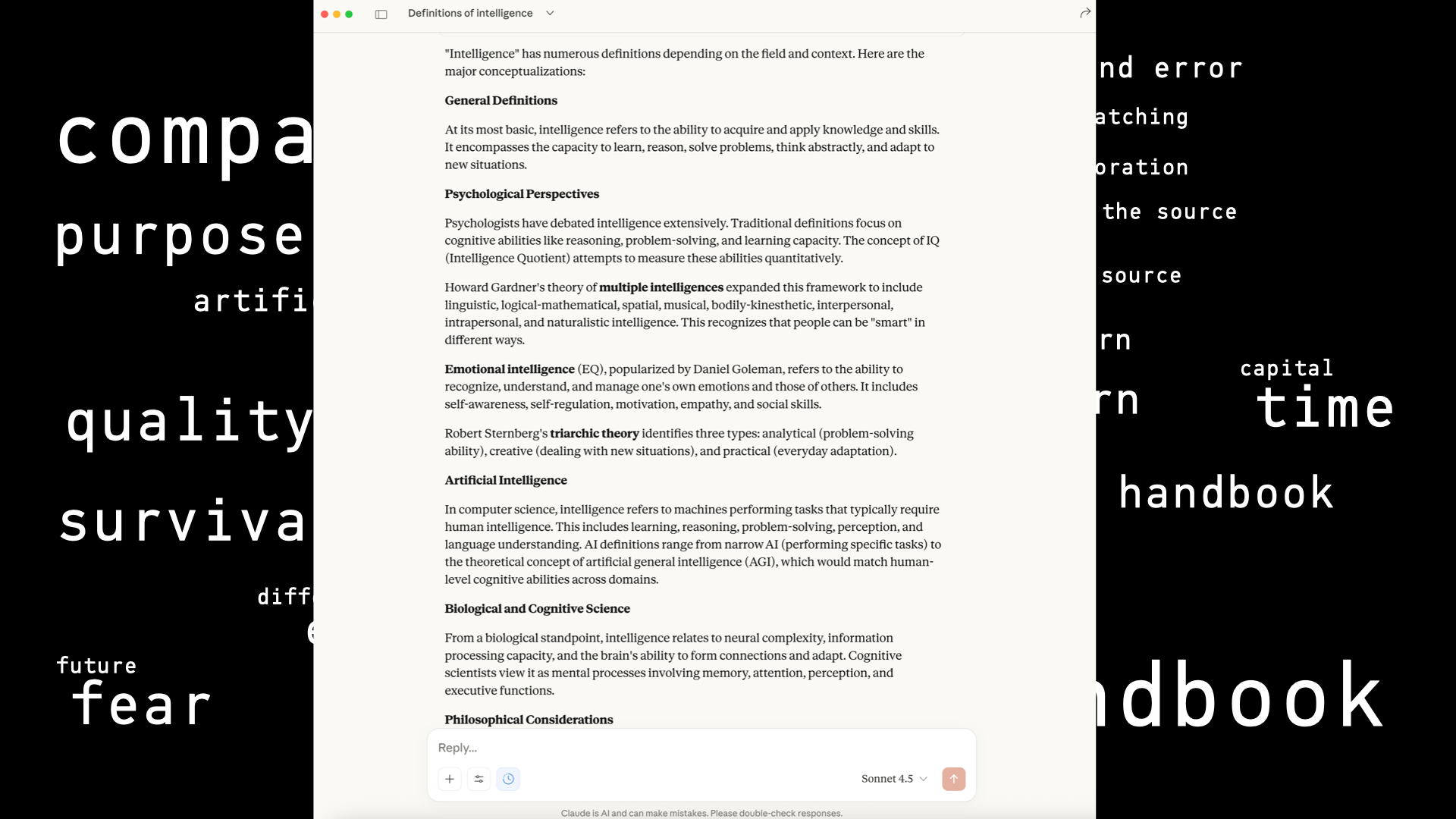
Note 6: What is intelligence:
This paper is a survey of a large number of informal definitions of 'intelligence' that the authors have collected over the years. Naturally, compiling a complete list would be impossible as many definitions of intelligence are buried deep inside articles and books. Nevertheless, the 70-odd definitions presented here are, to the authors' knowledge, the largest and most well referenced collection there is.
Covers multiple perspectives: historical evolution, psychological theories, modern approaches. Includes emerging concepts: collective intelligence, ecological intelligence, digital intelligence. It's a comprehensive overview of how definitions have evolved over time.
A cross-disciplinary approach: computational intelligence and psychology. Addresses contradictions between different fields' definitions. Argues there is no consensus and that terms are used with "similar, opposed, or even contradictory definitions.
Note 7: Knowledge ≠ Intelligence:
A recent psychology study that explicitly distinguishes intelligence from knowledge and shows they are asymmetrical constructs. It finds that people often conflate them, but scientifically they have different roles.
Research distinguishes natural intelligence from artificial systems that mostly process information without full human-like understanding.